The Community Archaeology Program: The Stockade and Beyond
By: Dave Moyer, Owner and Principal Investigator of Birchwood Archaeological Services
Since its founding, the Community Archaeology Program (CAP) has filled an important and much needed role in uncovering and preserving Schenectady’s rich history. Since that time, the reputation of the program has grown, making CAP an important center for archaeological research. In the process, CAP instructors have partnered with local organizations to provide guidance, expertise, and logistical support to uncover important information about the past which would otherwise have been lost. For students 16 and older, CAP offers a unique opportunity to explore careers in archaeology or pursue long held interests.
Following is the first in a series that demonstrates how CAP has helped to foster archaeological research beyond the border of the Schenectady Stockade - within the broader Capital Region.
 CAP at Knickerbocker Mansion
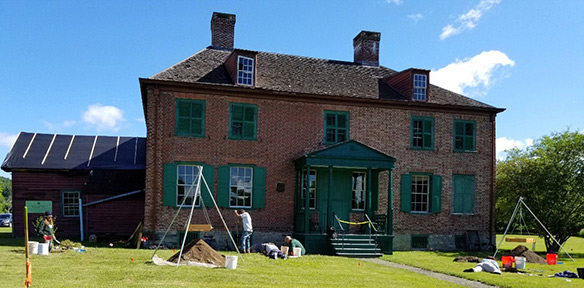
In the spring of 2022, CAP instructor Vivian James was contacted by Leslie Allen of the Knickerbocker Historical Society about a research question that they had long been curious about. The Knickerbocker Mansion is a large c.1780 brick house located in the Town of Schaghticoke that was undergoing restoration.
Previous excavations conducted in the 1980s had encountered stone foundation remains from an earlier structure in the front yard of the house. Members of the historical society had questions about this earlier structure, such as its size and orientation of the building, function and approximate age.
Over the course of two field seasons, CAP instructors, students and alumni helped to excavate the remains of the former structure in the front yard of the house. The fieldwork was conducted through partnerships with the Knickerbocker Historical Society and the Adirondack Chapter of the New York State Archaeological Association and was guided by consultation with the Stockbridge-Munsee Community Band of Mohican Indians whose ancestors once lived there. A ground penetrating radar study conducted by CAP instructor Dan Bradt helped to delineate the approximate location of the foundation walls, which minimized the amount of ground disturbance and preserved large sections of the front yard. The study was also a highly successful public outreach opportunity, with local community members and a local Boy Scout Troop assisting in the excavations and lab work. Ultimately, CAP excavations were able to determine that structure in the front yard was indeed a former residence dating to the late 17th or early 18th century and was oriented in a slightly different angle than the later c. 1780 mansion. To learn more: Knickerbocker Historical Society.
Hands-On Archaeology for Kids and Teens
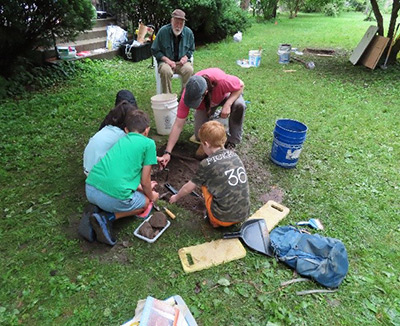
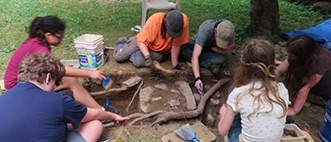 In July, CAP held two successful weeklong sessions of Hands-on Archaeology, one for
Kids and one for Teens. Both groups were filled to the maximum student number. Several
of the participants were repeat attendees. Under the guidance of the instructor, they
engaged in age appropriate aspects of an active archeological excavation. Fire insurance
maps of Schenectady and limited photographs show the dwelling frontage and its outline
on the Ferry Street lot. It was a 2-story brick single family home with an extension
which was demolished in the 1960’s.
Summer youth activities focused on uncovering part of the extension’s foundation remains and the memorial garden landscaping that followed. The groups also found a midden (a term used for a trash deposit). In place at the bottom is a 1900’s lead water pipe that appears to be a replacement for the 1880’s clay pipe fragments found in the same trench. The students found a variety of styles and patterns of ceramics and other waste items.
Come see the artifacts and an excavation in progress for yourself at the CAP “Archaeology in Action” exhibit at the 60th Stockade Walkabout, September 26.
On Exhibit:
- Photos and fire maps of the original structure
- The memorial tree exposed root area
- The midden
- Water pipe fragments
- Ceramics
Interesting Things We’ve Unearthed
Albany Waterway Canal Project
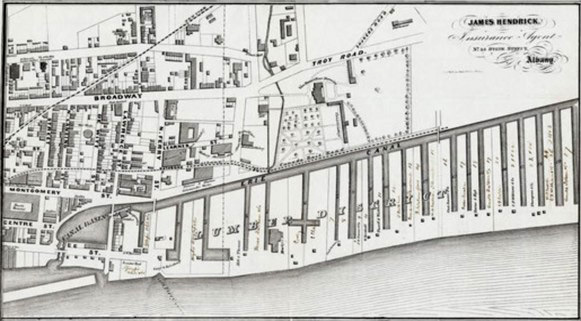
Though much of CAP’s efforts are in Schenectady, a recent dig in Albany highlights
the importance of the Erie Canal to both cities. The editor visited the excavation
which was completed in August by Hartgen Archeology Associates in conjunction with
Albany Waterway Inc. The excavation area sits on an island of land near the ramp of
787 Exit 4B and a parking area under 787. The purpose was to find remains of Lock
1 of the Erie Canal which was the starting point of the canal. Adjacent to this lock
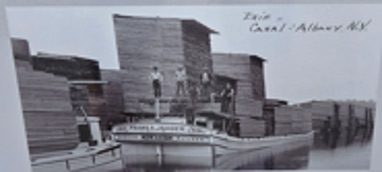
was a large basin and north of it was a 1.5 mile area known as the Lumber District.
This commercial area was the largest wholesale white pine market in the nation in
the mid-19th century. The 1856 map above shows many slips leading off the Erie Canal to the sawmills.
Hartgen’s efforts unearthed huge stones that were part of the support of the gates
to the lock as well as one of the outer walls. The lock was abandoned in 1921 and
filled with soilshortly after by the Delaware and Hudson Railroad. 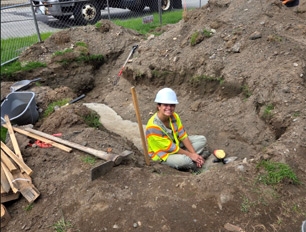 A soil scientist was brought in who was quite interested in studying the samples of
 century-old soil. An earlier study also looked at the nearby weigh lock building which
served as a giant scale to weigh cargo boats and determine tolls.
The project is part of the planning efforts to open a waterway in Albany similar to the original basin at the time of the canal. A completed feasibility study lays out three potential options to make this a reality. To increase public awareness, the site excavation will remain open with interpretive panels.
The Mound Digger
There is a movie in development titled, “The Mound Digger,” that touches on the archaeology field. It is being produced by Heritage Motion Picture Group though no release date is yet announced.
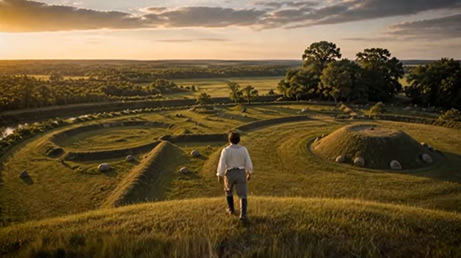 On the Mound Digger YouTube page a teaser trailer can be seen. The movie portrays the story of Ephraim Squier (born
in Bethlehem, NY) who mapped and surveyed numerous earthwork mound sites across the
Midwest, Ohio River Valley, and Mississippi Valley during the 1840’s. His career was
quite varied as he was a newspaper editor, diplomat, and archaeologist. While working
as a newspaper editor at Chillicothe, Ohio, he began to explore the mound sites nearby.
He partnered with archaeologist Edwin H. Davis. Their findings were included in the
first Smithsonian Institution publication. These findings summarized the knowledge
of the mounds at their time and served as a model for later research that still remain
relevant today. The movie explores conflicts between the Native Americans, the federal
government, and the railroads and the desire to develop the land. Though this editor
cannot vouch for the veracity of the details of the conflict storyline, the archaeology
segment should be interesting.